entwurf
Work with AI in another harness, without taking it out of its own home. Open visible sibling sessions and address them by garden id. Their authentication, tools and conversations are not absorbed into one execution engine.
Call a sibling, not a replacement harness
A session that has spent hours reading the code and a session bringing a fresh review need different places. Changing a model inside one conversation, or collecting every tool and record inside one agent, is not the only way to collaborate.
Entwurf puts a narrow connection between independently running harnesses. Pi, pi-durable, Claude Code, Codex, Copilot, OMP and Antigravity keep their execution, authentication, tools and transcripts. A sibling is an independent session with its own conversation, not a disposable worker. Different capabilities do not make a hierarchy of siblings.
0.40.0 — a bridge crossed, questions carried forward
A message to an existing sibling crossed between two machines, and an answer came back. 0.40.0 carries that first exchange. A person lays the bridge: the operator connects the machines, owns SSH authentication, and declares which pair may talk. The remote route crosses only that bridge. It does not discover siblings, open them remotely, or resend because an answer has not arrived.
The first trial was one pair of already-open pi-durable siblings on two Linux machines. One message, one reply, at a pre-release commit—not a new measurement at the shipped SHA or remote certification for every harness and platform (first exchange).
Today’s boundary is the operator’s SSH account and a declared pair, not cryptographic identity for a sibling. A person keeps visible-first by holding the sessions open; the code does not prove that a screen is visible. Acceptance is not a read, and an error is not proof of non-delivery. Instead of presenting these questions as solved, the release carries principles and open questions for remote siblings.
Open, reopen, message
Open
entwurf_fresh_call — Open a sibling in a new Herdr tab or, outside Herdr, a new tmux window. Its own callback establishes the new garden id.
Reopen
entwurf_resume_call — Reopen a dormant pi sibling in tmux under the same garden id. The record supplies model, conversation and working directory; no hidden turn runs.
Message
entwurf_v2 — Reach an existing sibling through its harness’s delivery rail. Delivery does not launch or resume a sibling runtime, and acceptance is not a completed reply.
A garden id does not replace the harness’s session id. It is a shared address attached to that native session. A window title or position is not an address, and an opened window is not proof that a sibling answered.
Inside real Herdr: Pi ↔ native Claude Code
Two siblings keep their own harnesses and transcripts, meeting through garden ids and official Entwurf verbs. This is the original demo from the 0.35.0 period, not a new recording of the two-machine crossing or proof of every upgrade path.
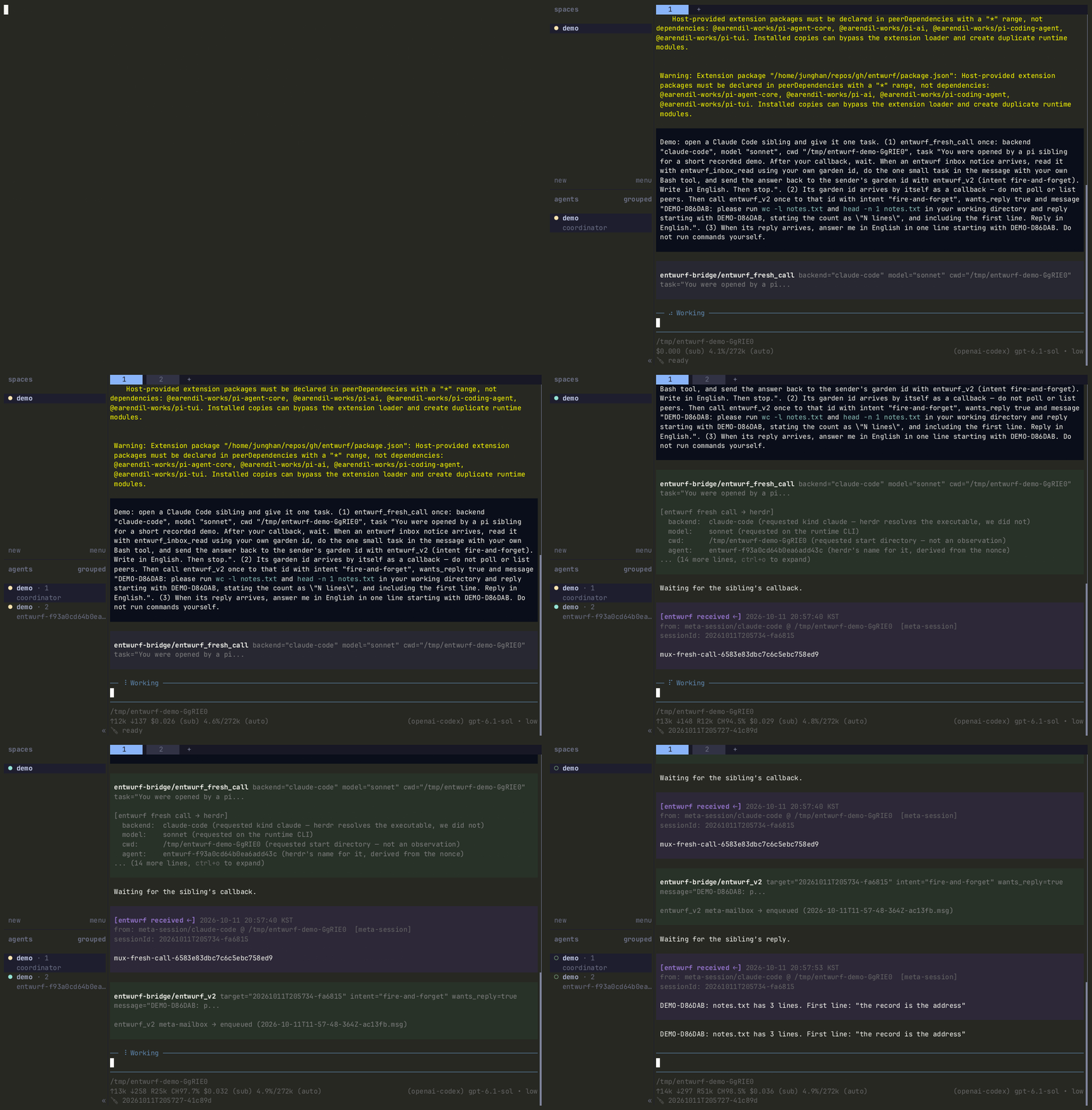
Original demo and reproducibility boundaries
Two workspaces, one address
Already using Herdr? The plugin activates Entwurf for integrated Pi and Claude Code sessions and opens siblings in new tabs in the caller’s workspace. An optional read-only pane shows the citizens’ visible placement. The plugin does not install a harness, subscription or login.
# First prepare Pi 1.3 and Herdr's pi / Claude Code integration
herdr plugin install junghan0611/entwurf/plugins/herdr --ref v2026.10.20-herdr.0.40.0 --yes
pi --entwurf-control
Outside Herdr, use the direct installation and tmux. Fresh-call supports six backends: Pi, pi-durable, Claude Code, Codex, Copilot and OMP. Antigravity has native-push delivery into an existing live conversation, not fresh-call support. Follow the README for installation and the Herdr guide for prerequisites, updates and removal.
Current releases and boundaries
As of October 20, 2026, core v0.40.0 and Herdr plugin 0.40.0 are paired. Herdr acquires the same npm 0.40.0 bytes accepted for the core release, with an integrity pin. Ordinary Pi support is >=1.3.0 <1.4. For pi-durable, the upstream SDK retains the execution engine, authentication, queues, SQLite, transcripts and recovery.
| Surface | Connection and boundary |
|---|---|
| Pi | Unix control sockets on non-Windows; named pipes in the bounded Windows preview. Same-id dormant reopening is limited to Pi in tmux. |
| pi-durable, Claude Code, Copilot, OMP | Each receives messages through its own self-fetch rail. Pi’s same-id resume support does not carry over. |
| Codex, Antigravity | Native push into a live conversation, not a mailbox or automatic resumption. |
| Herdr plugin | Activates and opens Pi and Claude Code. Durable-on-Herdr remains a separate pilot. |
| Remote pair | Connects existing siblings on two operator-declared machines, without remote launch or resume. First demonstrated with a pair of pi-durable siblings on Linux. |
Native-Windows Pi remains a bounded preview introduced in 0.39.0, not certification of other Windows harnesses, Herdr, tmux, fresh-call/resume or a real vendor model. This Herdr snapshot’s install/use/deactivate/reinstall evidence also stays within a clean Linux container at the public main ref: it does not cover a tag-ref install, real panes or model work. Detailed scope belongs in the support record and release acceptance record.
Claude ACP inside Pi and a native Claude Code sibling are different routes. Entwurf does not present their tools, thinking levels or restart behavior as equivalent, or reimplement another harness’s internals to fill a feature promise.
Houses that keep their own work
- agent-config — Shared skills, profiles, working agreements and the lived proving ground. Entwurf does not take ownership of that environment inside every harness.
- andenken — The memory axis for recovering decisions from past conversations and the public garden. Retrieval is not proof that a running session was restored.
- Each harness — Its own authentication, execution, tools and conversation. Different capabilities are not disguised as one uniform surface.
This is the project’s front door. The repository owns installation and execution contracts; the resident’s note keeps dated judgments and boundaries.